Thursday, November 4, 2010

Mamey sapote ice cream

I've made mamey ice cream a couple times before, but I tried something a little different this time around.

In earlier ice cream recipes, I've seen a big difference in batches made with raw and cooked fruit. Mango had a particularly profound transformation in flavor making an entirely different ice cream. Cooked recipes with mamey are rarer than with mango, but not entirely unheard of. I've never tried one so I was curious to give it a try.

Here's the sapote I used. According to the guy at the market stand, it's one of the last of the summer mamey crop and a different variety than get in the winter. More fibrous for one thing. No huge difference in flavor though, if I'm remembering right over the months. I didn't get many details from him so if you know something about this, do please share in the comments.

I started by scooping out a couple cups worth of pulp, mashing it up with a half cup of sugar and put it over a low heat to cook. I, thoughtlessly, expected it to break down like mangoes do on the stove-top; I should have known it would have a texture more like sweet potato. It took a lot of attention to keep it cooking without burning, but over ten minutes or so it turned into a paste and developed a bit of a caramelized smell.

I didn't want to risk burning it went out of the pot and into the blender with:
1 cup heavy cream
1/2 cup milk
1 Tablespoon cream cheese (which seems to help scoopability)
the juice of 1 lime
2 teaspoons vanilla, and
a few dashes cinnamon

But it was too thick to blend properly so it definitely needed thinning down. I added another half cup cream, a quarter cup of a tropical juice blend and a couple Tablespoons of agave nectar which does a good job of bringing out fruity flavors along with bolstering the sweetness.Finally, I wanted to add some alcohol to keep it from freezing solid. I'm out of vodka and rum which would have been my first choices, but found that the flavor of dry sake and mamey go really well together. (There's a pretty good cocktail in that combination for those interested in experimenting in that area.) I just added 2 Tablespoons to complete the recipe and gave it a serious blending.

After all that, the mix was still pretty thick, but I was pretty sure I'd added enough alcohol and fructose to keep it from thickening up too much further and my churn's got a relatively powerful motor so I was in good shape as long as I kept an eye on it.

Here it is right out of the churn:


and here it is after ripening in the freezer:

It did freeze up a bit more solid than I would have liked, but it is nearly 50 percent fruit so that's bound to happen.

Despite all the tweaking, the mamey flavor is clear, but in a mellow ice-cream-flavoring way instead of a fruit smoothie in-your-face way. There's an vapory hint of sake in the aftertaste which cuts the starchy throat-coating effect blended mamey can have so that's nice. The texture came out dense, but easily scoopable straight from the freezer (at least from the work freezer which is a bit warmer than my home freezer) and nicely smooth if not exactly creamy (despite all that cream in there). There's no hint of the fibers from the original fruit and just a little of the typical mamey grit.

So did cooking down the mamey make any difference? A bit in the texture I think, but it was a real disappointment that it didn't seem to change the flavor at all. There's probably some interesting bio-chemical reason for that. Non-volatility of the flavor compounds or some such. But the upshot is that this ice cream is pleasant enough, but nothing to get exercised about and a disappointment only so far as the new flavor territory I delved into is indistinguishable from the old.

Sunday, October 31, 2010

Salt baked shrimp

I mentioned in my previous post that I bought some shrimp along with the conch I used there. What I didn't mention was that these shrimp were about 18 per pound (headless) which makes them Extra Jumbo. A pretty good price for such sizable shrimp too, I thought, until I did some math and realized that a good price per pound still meant I was paying nearly a buck a shrimp. So, the question became what to make that would take best advantage of the unusual size I was paying a premium for.

My original plan was to try a dish I remember from a Good Eats episode where you bury the shrimp in salt and cook in a baking dish. That, it turns out, is called salt roasted shrimp; salt baked shrimp is something else entirely. It's actually salt boiled, deep-fried and then stir-fried shrimp.

On Chinatown-online.com it says "The name is a result of the historic popularity of salt-baked chicken, which led to many foods being called "salt-baked," even though they were not, says Yin-Fei Lo." I'm assuming that's Eileen Yin-Fei Lo who's written a bunch of Chinese cookbooks and, although I know nothing of this historic popularity of salt-baked chicken, I'll take her word for it.

The three step process would be easy enough to do in a restaurant kitchen but it's a bit of a pain at home.I simplified by merging the deep-frying and stir-frying steps into a shallow fry and making some other adjustments to compensate. It does lose a little by this--mainly the little bits of fresh hot pepper embedded in the crust. That's a shame as it add as a rather nice dimension of flavor. I'm not sure I'm explaining this well so I looked for an image to illustrate. I couldn't find one, but you can see them in this salt baked squid image I found.

I just noticed in all the salt baked shrimp images, the shells are whole which means they weren't deveined. Big shrimp means big veins filled with lots of icky shrimp crap so I don't consider that a viable option. I found that I could cut through the back of the shell and the back of the shrimp simultaneously with a pair of scissors so it was pretty easy to get through the batch. It was a two handed operation, though, so tough to get a picture of the process.

In the original recipe, the boiling step was just a 10 second blanch, to remove liquids, the deep frying for a minute to cook and create the cornstarch crust and the stir fry a few moments to coat with salt. I adjusted to a 40 second boil to cook the shrimp most of the way through and then 30 seconds per side in the shallow oil to create the crust. I put the salt directly into the cornstarch slurry along plenty of black and white pepper. That technically turns this into a version of the much more sensibly named salt and pepper shrimp, but I started out making salt baked shrimp so I'm sticking with that for the post.

Here's the result:


I probably should have used a thicker cornstarch mixture to get a more robust crust, but this turned out pretty well, I thought.The crust is light and crisp with a surprising amount of flavor past bold salt and spice, the shells crisped up too and the shrimp cooked up tender. I was winging it on the oil temperature and cooking times so the good results were probably due to jumbo shrimp having jumbo margins of error too. That makes it a good use of the large shrimp so mission accomplished. The coating to meat ratio wouldn't have worked with anything much smaller so there's that too.

The open shell did capture a bit of oil, though. The alternative was leaving the veins in so I think I made the right choice. I'll need to do some better draining next time or at least serve with enough rice to offset the greasiness. The greasiness moves this from sophisticated dim sum to a beer-accompanying finger food. Not bad at all, just not classy.

Wednesday, October 27, 2010

Lambi au Riz

Aaaand we're back.

To be honest, it's too soon. My kitchen is still unbearably hot most days and South Florida is weeks from its first harvest of the season, but a new market (I'm not going to call it a farmer's market has there's no sign of farmers as yet) has opened up at UM literally steps from my office and there's just too much tempting there to not start cooking again.

Case in point, the seafood stand (whose name and proprietor I would have made note of if I had decided at the time that I was definitely going to be writing this up) had some fresh local conch and shrimp at quite a reasonable price. I've never cooked with conch before so I bought a pound.

I did a bit of research to find my options on what to do with it. Basically, they were fritters, ceviche, chowder and stew. I haven't been impressed the fritters I've tried--isolated rubbery bits in a big ball of dough--and I'm suspicious of the texture of notoriously tough conch in a ceviche. So it's down to chowder and stew which are the same thing give or take a couple cups of stock.

Oh, there's also grilled conch steaks, but I really wasn't up for that as the conch I bought was cleaned but not tenderized. I had the choice of banging on them with a hammer for a while or grinding them up in the food processor as most of the chowder and stew recipes called for. On most days I think I'd go with the hammering, but not today. I settled on chowder for a while, but eventually switched over to a stew. And, as you'll note from the title of this post, the dish mutated further.

The stew and chowder recipes generally start with either salt pork or bacon. The bacon struck me as a more readily available substitution so I was going to go with salt pork until I read the recipe from the Bacon Cookbook which made a convincing case for bacon's smokiness pairing well with the clam-like flavor of the conch. So three thick slices, cut into lardons, went into the pot along with a little cooking oil (I'm using a 50/50 olive/canola blend for this sort of thing these days), cooked slowly until crisp and then removed.

Then I added:
a knob of butter
3 cloves of garlic, minced
1 small onion, diced
1/2 red bell pepper, diced
2 small hot peppers (from the back of my refrigerator. Serranos I think.), minced
and a pinch of salt.

A stalk or two of celery should properly go in at this point too, but I haven't got any on hand and wouldn't miss it if it's gone.

I turned the heat down to medium low and sweated them for seven minutes to soften. Then I added a little more oil and two Tablespoons of flour and cooked for seven minutes more to make a roux. Given what I did to the recipe later, this step was probably wasted, but you've got other options so I'll leave it in here.

After the roux was nice and golden, in went:
1 14 ounce can of diced tomatoes, not drained
about the same amount of shrimp stock
2 teaspoons each dried oregano, basil, thyme and marjoram (I have three out of the four fresh at the moment so I considered going with a bouquet garni, but I think dried makes more sense for a stew)
1 pound ground conch (I thought I'd have less, as the recipes advised to trim off the tough orange bits, but the orange bits on mine didn't seem any tougher than the rest so there must be more that was already removed)
salt and pepper

I brought that to a boil, covered, turned the heat to low and simmered for 40 minutes.

At this point it was time to add a starch: small-diced potato according to most recipes with options of yam and yucca. But one recipe, at all-fish-seafood-recipes.com, suggested adding rice. That recipe is the only result Google finds for the phrase "lambi au riz" so maybe the author made it up himself. Lambi appears to be the name for the Haitian version of conch stew, though.

Anyway, I added a cup of rice (rinsed) and cooked for 20 minutes more.

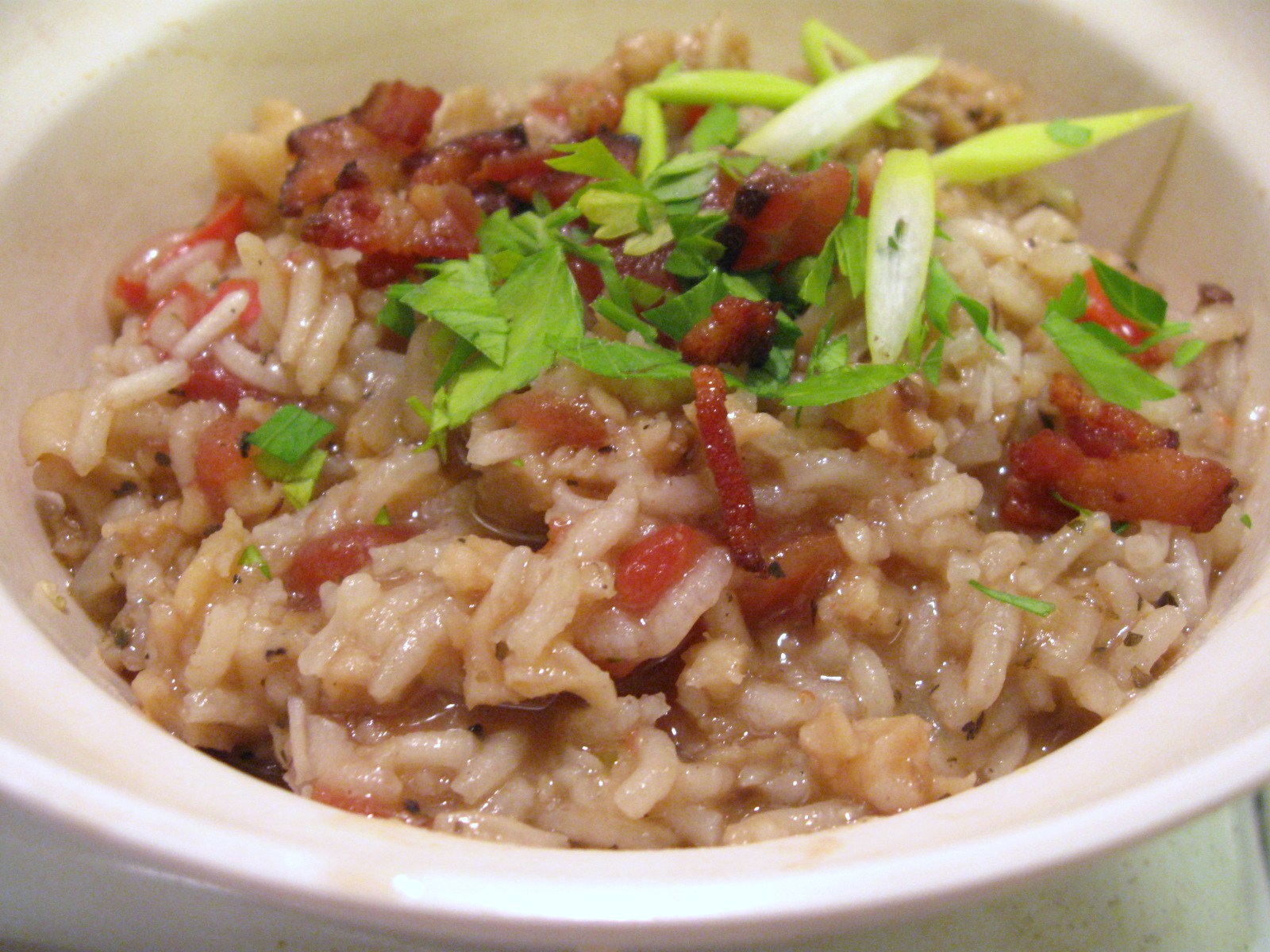
Here's the result topped with parsley, scallion and the reserved bacon.


And, after a taste, I discover something I should have noticed rather earlier. I've just made a batch of conch jambalaya and a pretty darn tasty one at that. Actually, the flavor is somewhere between jambalaya and Manhattan clam chowder. It starts with a bright tomato/shrimp gravy, rich and buttery and rounded with herbs, and fades into a smokey brininess. There's a sweetness up front and a bit of bitterness in the aftertaste too. Not enough to be actively unpleasant, but enough to prompt the next bite.

The textures worked out really well too. The rice has a little firmness to it and the conch just a little chew. Lucked out there, getting the timing right. The flavors are going to be better tomorrow, but I'll bet the texture's all downhill from here.

Still, an auspicious return to the blog, I think for an experimental dish to turn out so well and so interesting. Coming up next (although quite how soon I'm not sure) is a different take on mamey ice cream and I'd like to try making fabada. Xixón Café sells fabada kits with the Spanish beans and pork products portioned out, but there's some disagreement in recipes as to what else goes in there and on the details of the cooking method so it's not quite as easy as that.

Sunday, June 27, 2010

Closing up shop...

at least for the Summer.

During my last week's silence I was suffering through a bout of stomach flu. I wasn't cooking; I was barely eating; and even thinking about food wasn't such a good idea. At this point, I'm starting to recover and while I'm certainly pleased to end the not-eating part, the not-cooking and not-thinking-about-food parts, I'm kind of digging.

I know I'm not entirely thinking straight right now. I still feel oogy considering anything other than small portions of bland ingredients, but I think there's some lasting appeal in not working in a 100 degree kitchen, not wrestling with an electric stove top, not using a mystery box of vegetables on a deadline, not researching novel recipes for the blog, and just not thinking about food all the time.

I'm curious what else I might do with my time. I've been doing the serious foodie thing for about three years now; writing the blog, reading others including the big national ones, looking up recipes, getting involved in the local food community, all that stuff. I'd like to dial it back a bit and try another hobby. And I think it's right here when the marketers have started noticing me that I need to make the decision of whether I'm going Pro-Am or backing away. I don't think I'm that committed. I have got a variety of other interests, you know.

I'm still signed up for the CSA this fall and I could easily see coming back to both cooking with it and blogging about it with some renewed enthusiasm, but I'd be surprised if I do the intensive week by week run-down again. I made so many dishes that I enjoyed but never made again because I was always chasing some new idea, not just for something to post, but because "the new" became an end in itself. Part of it was putting out ideas for other CSA members--and I did help a few stumped folks here and there--but now there's my archive and several other folks who have blogged about their CSAs so I don't think there's any real need to keep it up.

My original idea for this blog was just a place to show off some cool things I cooked and on-going ideas. I did a bit of that with ice cream, learning to bake and finding new ways to work with black sapotes and canistels, but it's taken a back seat to the on-going grind of the posting schedule. Once I've had a break, I'd like to come back to that.

I'd like to thank you all for reading. It has been gratifying to watch my audience grow even if it's been from zero to minuscule. I hope the blog's been interesting and useful for you. I may well be completely back to normal and posting again next week, but if I stick with this then there may be nothing here until October. If/when things gear up again here I'll let some other Miami food bloggers know and, if they care, they'll pass the news along.

Bye!

Friday, June 18, 2010

Saag aloo

Back in February I made aloo palak which is pretty much the same dish, at least in concept. That recipe and this one use the same ingredients, but combine them in interestingly different ways, particularly creating the sauce out of onion instead of spinach. Seemed worth a try.

Ingredients:
1/2 pound potatoes, cut into 1 1/2-inch diameter pieces
1 pound spinach, cleaned well
1 large onion (or one small onion plus some garlic and some shallot)
1 1/2 Tablespoons cooking oil
1/4 teaspoon whole coriander seed
1/4 teaspoon whole cumin seed
1/4 teaspoon cayanne powder
1/4 teaspoon ground coriander
1/4 teaspoon salt
1 teaspoon fenugreek
4 ounces canned tomatoes

1. Heat a medium pot of lightly salted water to boiling. Add potatoes and cook until just tender, 10 to 15 minutes

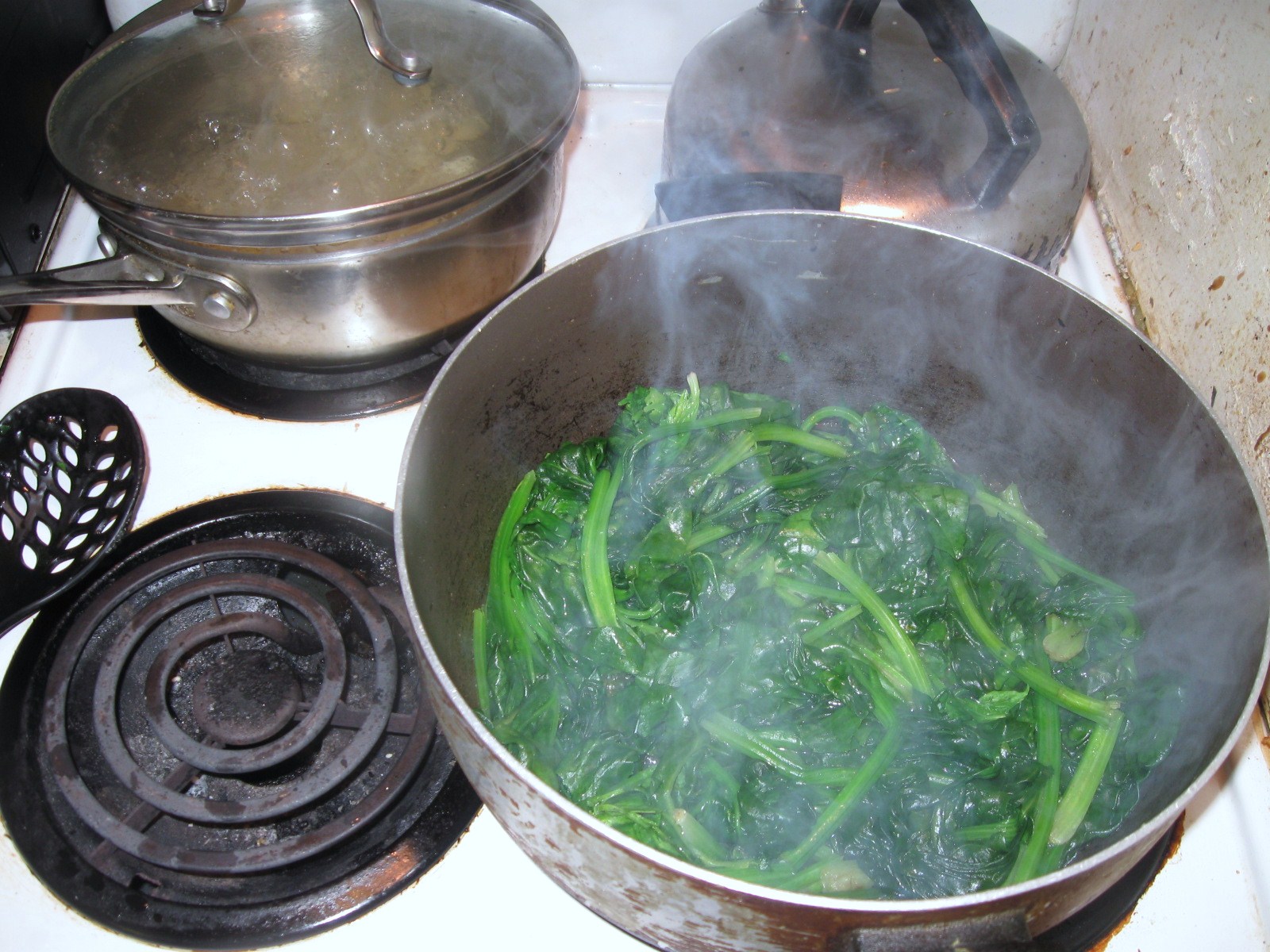
2. Heat a large pan over medium heat. Add the spinach with a little water from the cleaning. Cover and cook for 3 minutes. Remove from pan, let cool to handling temperature and squeeze out most of the moisture.

3. Slice the onion. Clean any spinach juice out of the large pan, add the oil and heat over medium heat. Add half the onion and sauté until golden brown. Add the whole coriander and cumin and cook for 1 minute more. Remove to a food processor.

4. Add the rest of the onion, shallots and garlic and blend until smooth.

5. Return to the pan and cook over low heat for 5 minutes. Add the potatoes, spinach and spices. Cook over low heat for 15 minutes. Add the tomatoes (the original recipe called for half as much tomatoes, but 2 ounces is barely any at all so I doubled it.), stir well, cover and simmer 10 minutes more.

Serve with rice or roti and a dollop of chutney.

The spinach is well overcooked, of course: on the verge of falling apart and a little mushy but the stems still have some texture. There's a bit of spinach flavor left plus mild spiciness, but the flavor is dominated by the onions and potatoes (which add welcome textural interest). It's all rather sedate so the spicy tangy bite of the chutney is a welcome addition. The amount of chutney in the picture is rather too much, but once I added another scoop of the saag aloo, it evened out nicely. It doesn't much resemble any restaurant saag aloo, I don't think, but it's been a while since I've had it. I wonder if this is a typical recipe or some weird aberation.

Monday, June 14, 2010

Cobaya PODzilla dinner

Sunday night Chefs Jeremiah Bullfrog, Chad Galiano and Kurtis Jantz catered another Cobaya dinner. There was some mention of the event being thrown together at the last moment, but you'll have to head over to Food for Thought for Frodnesor's inside scoop of how it came about. (He hasn't posted about it yet, but he always has plenty of insight and a more interesting comment thread than I get so it's worth waiting for.)

All of these chefs have done previous Cobaya dinners: Galiano and Jantz did Cobaya Gras back in February (I didn't do a full write-up, but here's Frodnesor's ) and Bullfrog did the P.I.G. event last November. That was before he had his GastroPOD ready to go. This time, he was able to roll it right up and have his customary kitchen with him. Galiano and Jantz set up in the location's backyard bar. By the way, notice the photographers in the picture of the POD. Including me, three out of thirteen people taking pictures at that random moment. That's a quarter of the crowd and that ridiculous ratio held true through the evening. I'm not sure what that means, but certainly nothing good.

The theme of the evening was elevated American(-ish) street food, but it had an unofficial theme of sous vide (although there was a little deep frying going on as well). Or is sous vide so standard in modern kitchens that it isn't worth commenting upon? Either way, enough ado. Here's the menu:


And here's what I thought of it.

First up was Chef Bullfrog's Octo Salpicon along with the Summer Spritzer. If pairing octopus with tomato, red onion and feta isn't a classic Greek recipe, somebody needs to tell the classic Greeks about it. It was a naturally harmonious combination with acid and spice up front fading to a very nicely flavored octopus. This was, without doubt, the tenderest octopus I've ever had.

I wanted to ask the chef to expand on his explanation of the preparation: "cooked the piss out of it," but he started the conversation by asking how everything was and I, with my reflexive honesty, told him that I didn't care for his Miami-renowned burgers (about which more later). It seemed a good idea to cut the conversation short not long after that.

Anyway, the spritzer went well with the salpicon. It was mainly salty and fruity with just a whiff of tequilla at the end. Could have used a little more kick for my tastes.

Next up, French Quarter Chicken Livers from Chefs Galiano and/or Jantz. (I wasn't sure who was responsible for what beyond if it came from the POD or the bar. No doubt one of the other blogs reporting on the event or an ego-surfing chef will be able to clear things up.) The livers were meltingly soft and straitforwardly livery in flavor (perhaps with some onion? They tasted a whole lot like my mom's chopped liver which does involve onion.) The hot pepper fluid gel was a very nice accompaniment and the salty crackers made the flavors pop. I've never had a sweet and tangy relish with liver before and was a bit surprised at how well it worked. I'll have to experiment at the next Passover sedar.

Next, brine fried chicken with Big Mike's potato salad and buttermilk-chicharrone biscuits. Steve, of the Blind Tastes blog, in a comment on chef Galiano's Chadzilla blog, said Mike's chicken was "not his real deal stuff" (although he still considered it "killer".) If what we got at Cobaya Gras was the real deal, I liked this better. That chicken has a very crisp very salty crackery crust that I thought overwhelmed the mild chicken. This time, for my piece at least, the crust was soft and soaked with chicken fat. That kept it from breaking away and brought its flavor together with the chicken. It was still quite salty and spicy, but if you had it with the meat in the proper ratios, it worked out right. Just a matter of personal taste, probably, as I've never cared for extra-crispy chicken.

The side dishes I was less thrilled with. The potato salad flavor seemed run of the mill to me and included the dreaded raw celery. The biscuits were dense and a little rubbery with flavors of raw flour and burnt oil. I did really like the chicken, though.

Next was the Crispy White Corn Cake (a.k.a. an arepa) with a poached egg, oxtail gravy, queso cotija and crema. Kind of an off-putting presentation. Certainly, the woman sitting next to me was put off. I know that's how sous vide eggs get so I dug in despite the undercooked appearance. The arepa was, as advertised, crispy, with a strong corn flavor that worked with the egg white. The flavor lightly spiced meat blended with the egg yolk while it was hard to distinguish between the textures of the soft fat and the egg white. So it came together as a tasty whole.

Next, the Banh Mi Taco (from the gastroPOD). This is a rather different dish from the banh mi taco chef Bullfrog prepared at the P.I.G. cobaya event last year, not least because it contains ox tail instead of pork according to one of his assistants. (I'm a bit embarrassed that I can neither confirm nor deny. It tasted kind of mystery-meaty to me, which is what I like in a taco, honestly.) The pickled radishes are new too she said. The Vietnamese flavors are mild, but was a pretty good taco. Could have used a little more acid and spice for me, personally.

Next, 'Baha' Fish Taco Salad. (Sorry about that vertiginous view of it. It's complicated and it was hard to get all the elements in from a better angle.) I lived in San Diego for five years so I'm particular about my Baja cuisine. 'Baha' generally doesn't cut it for me. But here I think they got most of the right flavor components in there. You need all three sauces: pico de gallo, a white sauce and a chipotle salsa, plus beer batter. The flour tortilla is a bit off and I don't hold with the deconstruction into a salad, but otherwise, pretty good. The avocado vanilla sorbet needs singling out as it was fabulously tasty and impeccably creamy. (Chef Jantz told me he used a Pacojet which, I'm sure you'll agree, is cheating.) I, and I think many of the guests, could easily have sat down to a few scoops of it on its own, but the sweetness in the salad was an off note for me.

Next, Chef Bullfrog's aforementioned Double Decker Slider Burgers. I just don't get these. First off, look at that pale flabby sous vide meat. The chef said he finished the patties off on the grill, but given the scant color here, it must have been momentary. OK, yes I know White Castle burgers are effectively steamed so a lack of color is traditional for a slider, but those aren't double decker which makes a difference. The sous vide process heats the double-thick burger through, but leaves the center with an undercooked texture that I really don't like at all. Also in the center are the bacon and cheese where their flavors are buried in all that unpleasant unbrowned meat. On the other hand, I liked the pickles and the bun was OK. If someone wants to defend the burgers in the comments please do so. Is this a typical example? What am I missing here?

The final savory course was Mississippi Delta Tamales. A Mississippi tamale is a rather different thing than a Mexican tamal. Chef Chad recommended tamaletrail.com for details and I concur; it's a very interesting site. These particular tamales were made with nicely spiced chicken confit with a little duck thrown in. The outside is cornmeal rather than masa. Both tasty, but it was really all about the sauces. The sweet tart tomatillo and the tangier ketchup brought out the flavors beautifully. Very nice indeed.

There was a bit of a gap at this point for the guests to catch their breaths and the chefs to have some dinner. Some folks started straggling off as it was getting late and they were getting full, but there's no such thing as too full or too late for dessert so they missed out.

First dessert was the Root Beer & Bourbon Floats. I spoke to Chef Jantz about this too. The "Zatarain's" on the menu is the brand of the root beer mix; the "Elijah Craig" the brand of the bourbon. The first is a New Orleans tradition, the latter carefully chosen to match. And match it did. Despite the serious boozy hit, the flavors of the bourbon and root beer blended seamlessly. The ice cream pulled out the vanilla notes in both and ties them together. Or possibly I'm full of crap and making stuff up.

Finally, we've got the White Chocolate Cupcakes. This is my exemplar of what a cupcake ought to be like. A modest amount of fluffy creamy buttercream frosting on top of springy cake with a pronounced flavor of its own. A pleasant little bite, not a monster with a half pound of frosting molded into a flower on top. My only complaint would be that there's no hint of the foie gras advertised in the frosting. Perhaps my taste buds had lost some precision at this point. My brain sure had.

Overall, a very pleasant evening. For other takes and more pictures, check out Frod's quick post from that evening on the official Cobaya blog and Chef Galiano's take here. I expect at least two more blog posts up-coming. Check back for links in the comments.

Sunday, June 13, 2010

Broccoli almond soup

Broccoli almond soup is interestingly ambiguous. A little push in one direction and it's Chinese, in another and it's Mediterranean. The basic recipe I worked from, from the Dairy Hollow House Soup & Bread cookbook, had it both ways. It used both sesame oil and sour cream for a fusiony effect. For me, the Chinese association was too strong. I could bring myself to finish it off with the sour cream and instead piled on garnishes with Chinese flavor elements. Maybe I missed out; I'll try sour cream with some of the leftovers.

Ingredients:
1 large head of broccoli, chopped into florets, thick stems peeled
6 cups chicken stock [I only had two cups of fairly condensed stock left so I just used water for the rest. I figured I'd get a purer broccoli flavor that way so maybe an improvement.]
2 Tablespoons butter
1 large onion, sliced
1 clove garlic, chopped
1/2 cup toasted almonds
3 Tablespoons sesame seeds
2 teaspoons sesame oil
salt and pepper to taste
sour cream, maybe

1. Bring stock to a boil in a dutch oven. Add the broccoli, turn down the heat to medium low and simmer for 10 minutes.

2. Meanwhile, melt the butter in a medium pan over medium heat. Add onion and sauté 5 minutes to soften and lightly brown. Add garlic and cook 1 minute more.

3. Move broccoli and onion mixture to a food processor. Add the almonds and sesame seeds. Process until smooth, adding broth to help the process along as necessary. [Sliced almonds will process better than the whole ones I had, but I liked the little chunks of almond that were left.] Return to the broth.

4. Bring back to a boil and simmer 1 minute to blend the flavors. Adjust texture with extra broth and seasoning with salt and pepper. [My low sodium, low chicken broth meant that I needed a whole lot of salt.] Mix in sesame oil.

As I mentioned up top, the original recipe just topped it with sour cream and called it a day, but I wanted to bring out more of the Asian flavors. You can't see it under there but there's a heap of brown rice in the bowl. On top are slices of Guilin-chili-sauce-and-soy-marinated pork chop and some cilantro.

Sans garnishes, the soup is intensely flavorful, with a bright freshness from the broccoli (despite the long cooking time) and a toasty nuttiness. It's fairly creamy considering the lack of dairy, and the imperfectly blended almonds add a bit of crunch. It's tasty but, personally, I find it hard to eat a whole bowl of soup where every spoonful tastes exactly the same.

The nuttiness of the brown rice blends right in with the other nutty elements in the soup. The combination of broccoli and rice is a cheap Chinese take-out for good reason so no complaints there.

The pork is a little problematic, though. I did an unexpectedly good job of marinating and cooking it to the right level of doneness so I really wanted to eat it on its own. It's still pairs well with the flavors in the soup, but it's a shame not to let it go solo when it's so good. What I should have done was marinate some beef in oyster sauce. That's the classic pairing with broccoli. While I'm making substitutions, some scallions instead of the cilantro would have been a better choice.

Well, I've got two containers of leftovers packed away and two plans of what to do with them. Good.