Showing posts with label shrimp. Show all posts

Wednesday, March 16, 2011

CSA week 14 - Camarones verdes

I found this recipe on the New York Times website with lots of basil with a bit of mint and tarragon substituted in to try to simulate the flavor of hoja santa. Well, no need for that for us lucky few. I traced it back to what looks like the original, from whence I got the Spanish name. It was buried on the third page of a Google search that ought to have popped it right up; Weird. Anyway, that page says it was published in the Dallas Morning News in 1998 as a preview of Diana Kennedy's cookbook: My Mexico. The NYT version only credits Martha Schulman, the author of the piece, but she did make some changes. For one, she broils the tomatillos rather than simmering them which seems an improvement to me. My version will mostly follow the NYT procedure with the big change of swapping out half the shrimp for potatoes, partially because the dish could use both a higher veg to meat ratio and partially because that's what I've got.

Ingredients:
1/2 pound tomatillos
3-4 hoja santa leaves
2 smallish hot chilies, de-stemmed but not de-seeded
1 pinch anise seeds [substituting for maybe-poisonous avocado leaves]
1/4 cup water
5 large garlic cloves, crushed
1 large pinch salt
2 Tablespoons olive oil
1/2 pound medium shrimp, peeled and de-veined
1/2 pound something else like potatoes or zucchini or more shrimp

1. Broil the tomatillos on a baking pan for 3-5 minutes on one side until charred [they'll start popping audibly at this point which is helpful], flip them over and broil 3-5 minutes more until that side is charred too. Remove to a blender or food processor making sure to keep the released juices.

2. Tear hoja santa, leaving the bigger veins behind [pretty easy actually]. Chop the chilies. Add both, the anise seeds and water, to the tomatillos. [Note from after the fact: also add one canned or dried-and-reconstituted chipotle pepper] Blend until smooth. Taste and season conservatively. Set aside.

3. Cook your something else until almost done [unless it's more shrimp].

4. Put garlic and salt in a mortar. Crush. Add olive oil and crush some more until you form a paste.

5. Add some more olive oil to a large pan and heat over medium-high heat. Add your something else if you want to get a bit of color on it. Season the shrimp then add it to the pan and cook about 2 minutes until not quite done. Remove both to a bowl.

6. Add garlic mixture to the pan and cook 30 seconds until aromatic. Add tomatillo mixture, bring to a boil, turn heat down to medium low, and cook around 5 minutes until the 1/4 cup of water has boiled out and the sauce has thickened slightly. Return the other ingredients and cook a few minutes more until everything is cooked through and the sauce coats the chunky bits.

Serve with tortillas if your something else wasn't starchy.


The sauce has the same tart, oddly herbal/medicinal flavor that I had a hard time describing the last time I made something using the combination. I doesn't pair particularly well with either the shrimp or the potatoes, but it doesn't actively clash either. You taste it, then you taste the shrimp but there's kind of a disconnect between.

Last year, I suggested adding some chipotle so I'm going to try that now to see if that helps matters... Yeah, it helps a whole lot. It lays a foundation for the tartness of the tomatillo and rounds out the hoja santa. It even makes the flavors blend with the shrimp. I can now honestly recommend making this dish if you add a chipotle or maybe some pimenton back in step two.

Thursday, January 20, 2011

Goan shrimp and vegetable curry

Suvir Saran, the author of the recipe I based this on wrote "I associate this dish's flavors with Goa" and "feel free to add whatever vegetables you want" so I'm guessing that this is not so very traditional. But it uses up three sprigs of the curry leaves, which is a lot for 4 servings, and "whatever vegetables you want" means a bunch of CSA vegetables I have so that's convenient.

Here's my version:

herb paste:
2 sprigs curry leaves, removed from stem
1 1/2-inch piece ginger, peeled and chopped
zest and pulp from 1/4 lime (substituting, poorly, for 1 Tablespoon lemongrass)
1/2 cup cilantro leaves and tender stems
1/2 hot pepper, chopped

1. Blend all that with a few Tablespoons of water into as smooth a paste as you can manage. Set aside.

Curry:
1 1/2 Tablespoons cooking oil
3/4 teaspoon whole cumin seed
1/2 teaspoon brown mustard seed
1 sprig curry leaves, removed from stem and roughly chopped
2 dried chile peppers
1/2 teaspoon ground turmeric
3/4 pound assorted vegetables, prepped (I used 1/2 pound green beans plus 1/4 pound baby bok choy)
1 can coconut milk
1/4 cup heavy cream
3/4 pound shrimp, peeled and deveined. Brined wouldn't be a bad idea either.
3 Tablespoons more cilantro, chopped
salt to taste

2. Put oil into a large pot over medium high heat. Add seeds. When they start popping, add curry leaves, peppers and turmeric. Stir and cook 1 minute.

3. Add the herb paste, reduce heat to medium low and cook 2-3 minutes more until fragrant.

4. Add the heartiest of the vegetables (green beans in my case) and some salt and cook until about half done, adding other, more delicate vegetables as appropriate.

5. Add coconut milk and cream plus some more salt. Turn heat up and bring to a boil. Return heat to medium low and simmer until vegetables are done to your liking.

6. Add shrimp and simmer 1-2 minutes until just cooked. Stir in cilantro, adjust seasoning and serve with rice.


And here it is:


All the sauce drained into the rice. Here it is still in the pot:


So, not bad. Not as intensely flavored as you'd expect given all those herbs and spices, but nicely fragrant of curry leaves. The coconut milk really takes on the cumin and mustard well and there's a little spice to it. My problem is just that the flavors are too distinct. The green beans taste like green beans and the shrimp tastes like shrimp. The sauce is nice but the rice soaked it all up. I think this is going to be one of those better the next day dishes. The flavors will blend with a good long soak.

Serving with some other starch instead of rice might be a good idea too. Chapatis maybe.

Monday, December 6, 2010

CSA week two - Stuffed eggplant in black bean sauce

I started this dish with a recipe by Richard Ng, the owner/chef of Bo Lings in Kansas City. The original recipe calls for slicing the eggplant into thick rounds, slicing a pocket into each, stuffing them with shrimp, deep frying them, making a sauce from scratch, dipping them in the sauce and then steaming them.

I changed it a bit to emphasize the eggplant over the shrimp and simplified it so it was suitable not just as a weekday dinner, but as a weekday after going shopping and discovering that Whole Foods doesn't carry dried shrimp any more so you can't do the callaloo recipe you wanted to and they also don't have creamed corn so you can't do the back-up recipe either, not as written anyway, dinner.

Instead of cutting the eggplant rounds, I just cut it lengthwise (and then across so so it would fit in the steamer), sliced off a little bit of the skin side so it would sit flat and then scooped out a shallow trench to put the shrimp in.

The shrimp, instead of cutting into pea-sized pieces and stirring for four minutes until it gets sticky, I just blended (with the scooped out eggplant) in a food processor into a coarse paste. Shamefully, I didn't even bother to devein them. I did season them with generous salt and white pepper, I should mention.

Instead of deep frying, I browned the eggplant on both sides in just a Tablespoon or two of oil. Since I made boats instead of sandwiches, I did this before stuffing the shrimp in.

As the eggplant cooled, I made the sauce. I started with Lee Kum Kee prepared black bean garlic sauce and doctored it up with a little of soy sauce, sugar, rice wine and sesame oil--all the ingredients in the recipe that weren't in the ingredient list on the bottle-- until I got the flavor in the right neighborhood. Then I added a little corn starch so the sauce would thicken up during steaming and stick to the eggplant better.

I flipped the eggplant boats over, spooned a little sauce over the bottoms, flipped them back, stuffed them with the shrimp mixture, put them into the steamer (in the same pot I fried them in earlier), spooned some more sauce over top, covered and steamed for 13 minutes. That's it.


I think I missed the mark on the sauce, but not too badly. It thickened up a little too much, but the flavor's pretty close to what I've had at dim sum places. The salty deeply savory richness pairs well with the sweet eggplant and shrimp, but it's maybe a little bitter. I should have added a little more sugar and it could have used some ginger too. Visually, it could be a lot more appealing, I'll grant you.

The thicker pieces of eggplant is falling apart, but the thin end holds together well. The deep frying in the original recipe must drive out enough moisture that it firms up and can survive the steaming better. The texture of the shrimp is pretty good, though--a nice meaty chew.

Overall, not bad at all for a quick dinner. The biggest problem was that it was best hot out of the steamer, but cooled down quick while I took pictures and stopped to write up my impressions. I'm not used to that happening in Miami. Weird.

Sunday, October 31, 2010

Salt baked shrimp

I mentioned in my previous post that I bought some shrimp along with the conch I used there. What I didn't mention was that these shrimp were about 18 per pound (headless) which makes them Extra Jumbo. A pretty good price for such sizable shrimp too, I thought, until I did some math and realized that a good price per pound still meant I was paying nearly a buck a shrimp. So, the question became what to make that would take best advantage of the unusual size I was paying a premium for.

My original plan was to try a dish I remember from a Good Eats episode where you bury the shrimp in salt and cook in a baking dish. That, it turns out, is called salt roasted shrimp; salt baked shrimp is something else entirely. It's actually salt boiled, deep-fried and then stir-fried shrimp.

On Chinatown-online.com it says "The name is a result of the historic popularity of salt-baked chicken, which led to many foods being called "salt-baked," even though they were not, says Yin-Fei Lo." I'm assuming that's Eileen Yin-Fei Lo who's written a bunch of Chinese cookbooks and, although I know nothing of this historic popularity of salt-baked chicken, I'll take her word for it.

The three step process would be easy enough to do in a restaurant kitchen but it's a bit of a pain at home.I simplified by merging the deep-frying and stir-frying steps into a shallow fry and making some other adjustments to compensate. It does lose a little by this--mainly the little bits of fresh hot pepper embedded in the crust. That's a shame as it add as a rather nice dimension of flavor. I'm not sure I'm explaining this well so I looked for an image to illustrate. I couldn't find one, but you can see them in this salt baked squid image I found.

I just noticed in all the salt baked shrimp images, the shells are whole which means they weren't deveined. Big shrimp means big veins filled with lots of icky shrimp crap so I don't consider that a viable option. I found that I could cut through the back of the shell and the back of the shrimp simultaneously with a pair of scissors so it was pretty easy to get through the batch. It was a two handed operation, though, so tough to get a picture of the process.

In the original recipe, the boiling step was just a 10 second blanch, to remove liquids, the deep frying for a minute to cook and create the cornstarch crust and the stir fry a few moments to coat with salt. I adjusted to a 40 second boil to cook the shrimp most of the way through and then 30 seconds per side in the shallow oil to create the crust. I put the salt directly into the cornstarch slurry along plenty of black and white pepper. That technically turns this into a version of the much more sensibly named salt and pepper shrimp, but I started out making salt baked shrimp so I'm sticking with that for the post.

Here's the result:


I probably should have used a thicker cornstarch mixture to get a more robust crust, but this turned out pretty well, I thought.The crust is light and crisp with a surprising amount of flavor past bold salt and spice, the shells crisped up too and the shrimp cooked up tender. I was winging it on the oil temperature and cooking times so the good results were probably due to jumbo shrimp having jumbo margins of error too. That makes it a good use of the large shrimp so mission accomplished. The coating to meat ratio wouldn't have worked with anything much smaller so there's that too.

The open shell did capture a bit of oil, though. The alternative was leaving the veins in so I think I made the right choice. I'll need to do some better draining next time or at least serve with enough rice to offset the greasiness. The greasiness moves this from sophisticated dim sum to a beer-accompanying finger food. Not bad at all, just not classy.

Thursday, April 22, 2010

CSA week 20 - Shrimp and celery escabeche

This is a recipe from Saveur that I found when I was looking around for pickled celery variations. The call it "Shrimp and Pickled Celery" which not only misplaces the "pickled" (since the shrimp is pickled too), but undersells the dish. The shrimp is cooked first so this is an escabeche, which is substantially more interesting than a straight pickle. That's why I chose to make it; I may not have done anything to prove it in the last year, but escabeche variations still intrigue me.

Other than halving it, and using most of a head of celery instead of two celery hearts, I didn't make any changes to their recipe. On their site, instead of reposting recipes from elsewhere, they just have a short description and a link. It would be rude for me rewrite their recipe here instead, I think. Here's the link for the full recipe, but it's pretty simple, really.

Throw together a bunch of herbs and spices with sugar and vinegar. Simmer to dissolve everything and cool.


Simmer the celery in flavored water. Remove to the brine. Poach the shrimp in the same water, cool, peel, clean, mix with the celery and let sit to pickle.

They give the range of soaking the shrimp and celery in the pickling brine for one hour to overnight. I found that even a few hours wasn't enough; it needed a full day. That may have been because there wasn't quite enough brine to cover everything so I added enough of the cooking liquid to get everything to float.

First off, let me recommend sticking with the original recipe's recommendation of using celery hearts instead of whole stalks. The outer stalks stay tough and stringy despite the simmer and soak. The heart and the leafy ends get nicely tender, though, and soak up some nice flavor from the brine and a little from the shrimp too. A good bit of celery flavor remains, though, so this is legitimately a celery dish. I wouldn't consider shrimp and celery an obvious pairing, but it's not uncommon. There's defnitely a synergy with the two together with the shrimp taking the edge off the celery's flavor and the celery underlaying the shrimp's light sweetness. Here, I think the sweet/tart/salty of the brine and dressing helps bring them together. I'm quite liking the dish, but it's best in small doses. Some appetizers you can make a meal of; this one's just too pickly.

Monday, April 12, 2010

CSA week 18 - Zucchini caldo de camaron seco

This is a bit of an improvisation. I was shopping for a Javanese dried shrimp and zucchini dish and not finding the Mexican dried shrimp where it was supposed to be at Whole Foods when I started wondering just what Mexican dried shrimp were used for.

If you trust Google, they're used for caldo de camaron seco--dried shrimp broth--mostly. Well, if zucchini works with dried shrimp and coconut milk, it might work with dried shrimp and chilies too. [I gave in and took the trip to Lucky Asian Mart I was hoping to avoid to get the ingredients.] Seemed worth a try anyway. I didn't follow any of the caldo de camaron seco recipes exactly even before adding the zucchini and I didn't really measure anything either; here's an approximation of what I came up with.

Ingredients:
1/2 pound dried hominy
1 medium tomato and 1 handful grape tomatoes
2 cloves garlic
2 not too hot dried peppers
1 chipotle pepper
1 Tablespoon olive oil
1 small onion, diced
1 carrot, diced
2 ounces by weight dried shrimp
4 cups water
1/2 large zucchini, diced

0. Soak the hominy 8 hours or overnight. Or quick soak it by boiling it for 5 minutes and then soaking for 3-4 hours.

1. Soak the peppers for 10 minutes to slightly soften. Remove stems and seeds. Cut or tear into small pieces.

2. Process the shrimp into a fine powder.

3.Blend the tomato and garlic. Add peppers and blend until very smooth. Press through a strainer to make sure. Add a little salt and taste. Add chili powder and/or hot sauce if the flavor isn't quite to your liking.

4. In a large saucepan or dutch oven, heat olive oil over medium high heat. When shimmery add the onion and carrot. Cook until the onion becomes translucent, then add the chili tomato mixture. Turn heat down to medium low and fry 10 minutes, scraping up the sauce if it sticks. [This is a typical Mexican technique. Interesting, no? Aren't Thai curry pastes treated similarly?]

5. Add the dried shrimp, hominy and water. Bring to a boil, turn heat to low and simmer for 50 minutes. Add zucchini and cook for 10 minutes more.

Top with diced white onion, a squeeze of lime and a drizzle of olive oil.


The ground shrimp has hydrated a bit and now has a meaty chew to it but in grainy sludgy form. It reminds of something, but I can't quite pin it down. Maybe somewhere between ground meat in chili and strands of overpicked crab in chowder. It's about as enticing as that sounds, but its not bad once you get used to it.

The broth itself is an earthy blend of the the fruitiness of the chilies and tomato and the salty minerally tang of the shrimp. That's pretty tasty. Kind of weird, but tasty.

The hominy could be softer; I should have cooked it a bit longer. And the zucchini could be firmer; I should have cooked it a bit less. [I adjusted the cooking time for the zucchini in the recipe above, but I'm not sure how to deal with the hominy. Follow the instructions on the package if you've got a package with instructions, I guess.] Still, their flavors come through nicely and do work well with the flavor of the broth.

Like the soup from a couple days ago, I think this one is going to work better tomorrow after the flavors have blended. I'll bet the textures will have improved too. ...

OK, it's tomorrow. The hominy and zucchini haven't changed so no improvement in the texture, but the flavors have melded nicely. Still, it's missing something and I'm pretty sure that something is pork. The flavor would fit in really nicely and the broth is so much like chili that I'm missing chunks of meat. I've got some pork in the freezer; maybe I'll give it a shot. I'll report in later...

Now it's the day after tomorrow. I've added some ground pork and, as long as I was at it, more zucchini and some red bell pepper. Now it tastes like a strangely shrimp-tinged chili. It was a much more interestingly distinctive dish before. Ah well; win some, lose some.

Friday, April 9, 2010

CSA week 18 - Gulai kacang udang

a.k.a. Sumatran shrimp and green beans

I think this is the first dish I've made with green beans and coconut milk. First one that I've blogged about anyway. It struck me as an odd combination, but I do recall seeing green beans as part of a lot of coconut-milk-based curries. Googling turns up Thai dishes with them paired along with some Malaysian and some Caribbean ones too. I'll have to put those on the to-do list when I get some more beans.

This particular recipe, according to The Indonesian Kitchen cookbook, is a typical Sumatran dish in that it's hot and acid without sweetness to balance as you'd find in a lot of other Indonesian cooking. I don't think it was quite as challenging as advertised, though.

Ingredients:
1 14 oz can coconut milk
1/4 cup onion, thinly sliced
2 cloves garlic, sliced
1 stalk lemon grass, crushed and/or slit open
1 teaspoon salt
1 salam leaf
1 small piece of laos
1/2 teaspoon fresh ginger, sliced
1 fresh hot chili pepper, sliced and crushed
1/2 teaspoon turmeric
1/2 pound string beans, cleaned and broken into 2-inch pieces
1/2 pound shrimp, peeled and deveined
1 small tomato, diced

0. Brine the shrimp and the string beans.[Don't skip brining the shrimp. They cook too fast to take on any flavor from the sauce (or add any either). The original recipe called for simmering the shrimp for a full ten minutes which would solve that problem but create a worse one if you ask me.]

1. Mix everything but the beans, shrimp and tomato into a pot over medium heat. Bring to a boil.

2. Add the green beans and simmer for 5 minutes, stirring often. Add the tomato and cook for 5-10 minutes more until the tomato has started breaking down and the green beans are tender. Add the shrimp and cook 1-3 minutes until cooked through.

Fish out the lemongrass, salam leaf and laos. Serve hot or warm over rice, garnished with crispy fried onion (or shallot or garlic), sweet soy sauce and chili-garlic sambal.

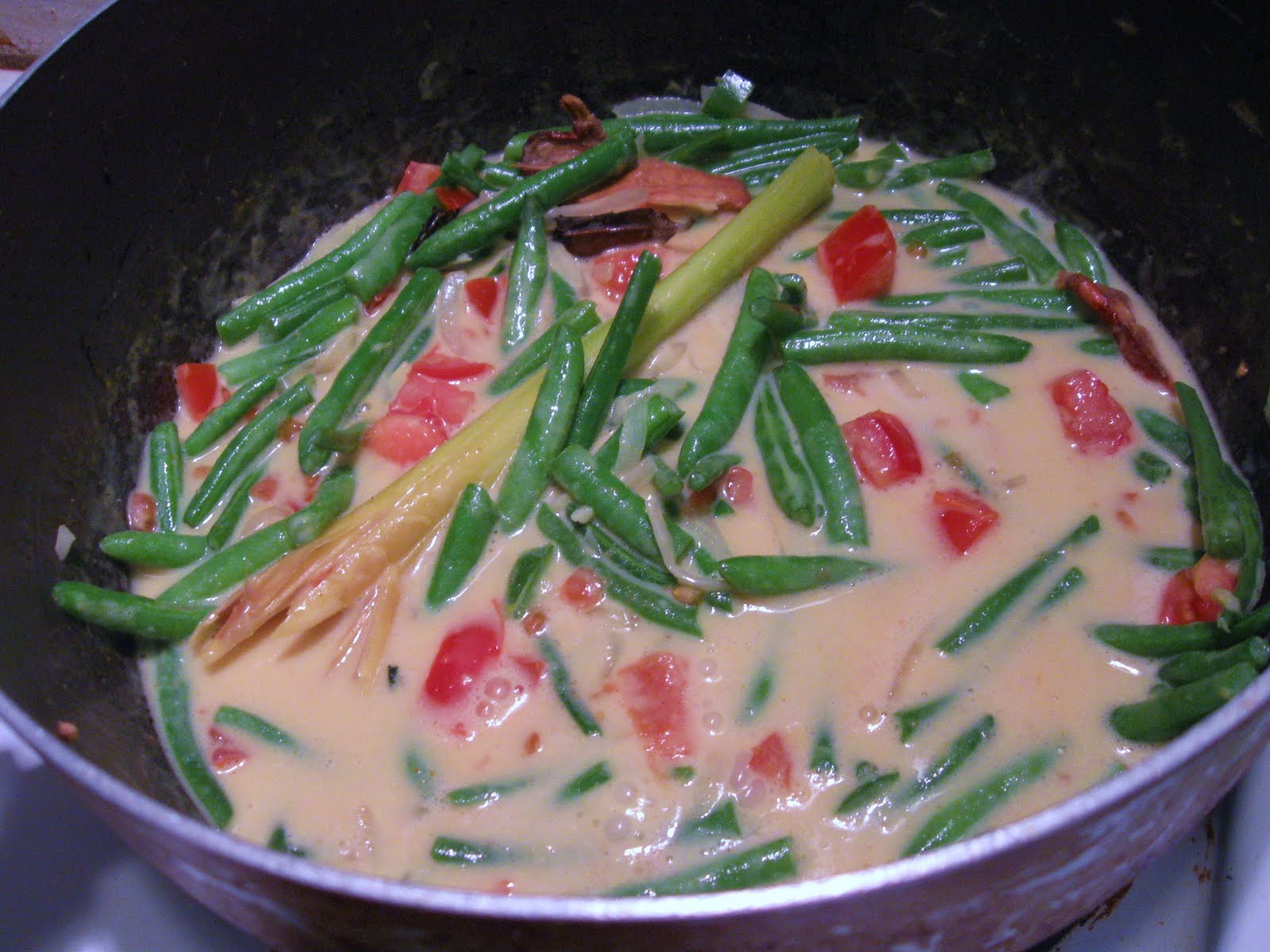
I couldn't get a good picture in the bowl since the sauce drained down into the rice. Here it is finished but still in the pot.


The sauce is richly flavored, spicy, creamy and fragrant with lemongrass and laos. A very nice complement to the shrimp, too. But the green beans are a spash of khaki against all that color. Blah in and of themselves and they don't really connect with the flavors in the sauce. Really disappointing. I should have brined them too maybe. I bet it'll be better tomorrow when the flavors have blended a bit.
---
OK, it's tomorrow and the dish is substantially better. Both the beans and the shrimp have absorbed a bit of flavor and the sauce has picked up a bit of depth too. Also, I hit it with a big shot of sriracha which did it no harm. I can now recommend this dish; just make it ahead and reheat.

Tuesday, February 23, 2010

CSA week 12 - Gumbo z'herbes

I'm not entirely certain about this. There are lots of recipes out there but they all agree on simmering the greens two hours or longer. Collards, OK maybe they can handle that. But chard and turnip greens? And what about the dandelion greens? Most of the recipes put them on the list of greens to include but nobody prepares them to deal with the bitterness.

I'm going to try it, but I dunno.

First step, clean and prep 2-3 pounds of greens--whatever you've got, the more variety the better. For those who haven't read the previous post, I had 1 bunch collards, 1 bunch chard, 1 bunch dandelion greens, 1 bunch turnip greens and 1 bunch radish greens. I did this prep the night before to avoid having dinner too very late.

Next step, get a gallon of water and/or stock (I used two cups of shrimp stock and the rest water) to a boil in a large pot and add the greens. Simmer for at least an hour.

Meanwhile,make a roux. I used the in-oven method. Mix equal parts fat and flour (I used 2 Tablespoons bacon drippings, 3 Tablespoons canola oil and 5 Tablespoons flour) in a big cast iron pot and put it in a 350 degree oven for at least an hour. No stirring necessary. The recipes that specify call for a peanut-butter colored roux, but they all also call for filé powder added at the end too. I don't have any filé so I'm not going to get that thickening. And, as you probably know, the darker the roux, the more flavor, but the less thickening power. So I pulled it out of the oven at around 1 hour 20 minutes. It looks peanut butter colored, but it started a little dark from the bacon drippings so I think I'm in good shape.

After that time, the greens have wilted considerably. Here they are along with half a cabbage, 1 bunch scallions and 1 bunch parsley that are going back into the pot with them later.

But before that, the pot with the roux goes up on the stove and in goes 1 large white onion, 1 green bell pepper and 3 stalks celery, chopped. I cooked that for 10 minutes over medium-high heat before adding the reserved stock and greens which I've roughly chopped, the cabbage, scallion and parsley (although what good scallion and parsley added this early will do I dunno), a ham hock, 2 bay leaves, 4 stalks thyme, 1 stalk rosemary, 4 allspice berries and a generous amount pre-mixed Cajun spice blend because I'm lazy.

It's at this point that I finally understand exactly how huge this batch of gumbo is. I'm going to be eating this for a month; it better be good.

Normally, that's the dish. Just simmer an hour more and serve, but I wanted it a little heartier so I added a couple links of andouille sausage and, 5 minutes before the end, a quarter pound of shrimp.

And here it is served over rice:


Hmmm...no real thickening at all. Or roux flavor, either, disappointingly. This is basically a huge mess of greens in a bucket of pot liquor. Lacking the filé powder, maybe I'll make up a slurry and bring it back up to a boil to thicken it up. It'll probably add a little raw flour flavor, but I'll trade that off for making this sauce into gravy. The greens still have a tiny bit of texture to them--the cabbage a little more--but mainly it's just soft. It's not falling apart like I expected though, so it's still in a pleasant neighborhood.

The flavors of the greens have all melded together to just a generic tasty green. No notable bitterness, or skunkiness from the boiled cabbage either. The herbs and spices round out the flavor a little and there's a hint of smokiness there. The sausage and shrimp weren't in long enough to swap flavors with the greens so they've retained all their flavor. The shrimp are a nice match, the sausage a bit less so. That'll probably change as everything melds in the refrigerator over night, though. I'll have some for lunch tomorrow and report back in a comment.

Wednesday, February 10, 2010

CSA week ten - Szechuan shrimp and scallion stir-fry

This is an exceptionally simple recipe from my favorite purveyor of exceptionally simple recipes, Mark Bittman. Here's his introduction:
"It isn’t often that I stumble across a dish that’s minimalist in every aspect: quick, simple, requiring few ingredients and yet sophisticated, or at least unusual. This stir-fry, a mixture of shrimp, scallions and not much else, is one of those."

Oh, I didn't notice that weaseling before. Unusual. That's a big step down from sophisticated. Well, I've already got the shrimp defrosted, peeled and deveined so I might as well go ahead and see how it turns out.

He tried a half dozen variations that detracted from the dish; maybe I can find an improvement he passed by. I suspect it's going to involve chili oil.

Ingredients:
salt
2 store (or 1 CSA) bunches scallions, cleaned
1 garlic clove, peeled
3/4 pound shrimp, peeled and deveined
1 Tablespoons peanut oil
1/4 cup cilantro, chopped

1 teaspoon black bean sauce
1 teaspoon Guilin chili sauce

1. Roughly chop 1/4 of the scallions. Chop the rest into 3- to 4-inch lengths.

2. Boil a pot of salted water and blanch the lengths of scallion for 1 minute. Remove to a bowl of cold water to stop the cooking. Put in a food processor with the garlic and a little of the blanching water. Blend until smooth.

3. Heat oil in wok or large pan over high heat. After a minute or so add the sauces. Stir and cook briefly until they become fragrant. Add the shrimp, toss and cook until almost fully cooked, 2-3 minutes. Turn the heat down to low, add the cilantro and the chopped scallion, toss, add the scallion purée. Stir, check for seasoning and serve with rice.


Oh yeah, that's some good stuff. The fresh bright bite of the scallion and the rich butteriness of the shrimp are the stars, but the sauces I added give it some subtle extra dimension and just enough of a savory backbone to tie it all together. Really tasty.

I think I missed out on sophisticated though. And it reminded me of Chinatown-standard scallion sauce so it wasn't all that unusual. Now I'm wondering what I missed by not making it straight.

Sunday, January 24, 2010

CSA week seven - Not quite banh pho xao he

This is a pretty straightforward vietnamese noodle dish modified from using a pound of garlic chives to using everything leafy and green within reach. The recipe I modified was from Andrea Nguyen's Into the Vietnamese Kitchen cookbook.

I cut the recipe down by about a quarter to adjust for the amount of noodles I had on hand. I'm going to use the original amounts to avoid weird numbers.

Ingredients:
1 pound banh pho flat rice noodles
1 1/2 teaspoons sugar, divided
3 Tablespoons fish sauce
3 Tablespoons water
2 Tablespoons cooking oil
3 cloves garlic, finely chopped
1/2 pound shrimp, peeled and cleaned
1/3 pound ground pork, broken up into bits
1/4 teaspoon salt
1 pound assorted leafy green vegetables [I used 1 bunch each of garlic chives, mizuna, swiss chard and cilantro], chopped or torn into 3- to 4-inch-wide pieces.
1 lime

1. Put the noodles in a large bowl and cover with hot tap water. Let them soak until pliable and opaque, 15 to 20 minutes. Drain. Cut into short lengths. The original recipe called for 3 to 4 inches, but I liked them a little longer.

2. Coarsely grind the shrimp into pea-sized pieces. Break up the pork into similarly sized pieces and mix with the shrimp.

3. Mix the fish sauce, water and 1 1/4 teaspoon of the sugar in a small bowl.

4. Heat oil in a wok over medium-high heat. Add the garlic and fry until fragrant, about 15 seconds. If it took less time and/or the garlic started to brown, turn the heat down; this isn't real stir-frying. Add the shrimp and pork. Break up the meat and add the salt and remaining sugar. Cook, stirring and breaking up clumps, until shrimp and pork have turned opaque, about 2 minutes.

5. Add the greens. Stir and fold to mix in the shrimp and pork and get different bits of the greens on the bottom. When the greens have wilted down by a third, add there's room in the wok, add the noodles. Mix well and add the fish sauce mixture. Turn the heat up until the sauce starts to sizzle and continue stirring 2 to 3 minutes longer, until the noodles and greens are soft and the noodles have absorbed a bit of sauce and darkened in color.

6. Remove from heat and squeeze in the juice from the lime. Mix once again and serve.


Hmm. Not bad. The shrimp and pork are, of course, great together and enhanced by the fish sauce. [When genetically modified lab-grown meat improves (right now they can just do a meat paste suitable for hot dogs and not much else and they have to use cells from animals that actually exist), they really ought to work on shrimp-pig.]

The chard goes pretty well with the other flavors and adds a substantially different flavor and texture than the garlic chives which I think is an improvement in the dish. The mizuna and cilantro seem to have wilted away to nothing, though, which is a shame.

I used the milder Vietnamese fish sauce so it's a low key dish that could do with some nuoc cham (or at least a little more fish sauce and lime juice) and sriracha to perk it up and maybe some fried garlic or shallots for crunch. Most Vietnamese recipes, I think, assume you've got your condiments and garnishes on hand to finish the seasoning of the dish. I added ground peanuts to my first serving, but the flavor isn't quite right. Fried garlic is a much better choice.

Monday, December 28, 2009

CSA week four - A couple of compicated salads

I don't think it struck me until just now, after the fact, that this week's CSA share (the half-share at least) is better suited to salads than cooking. I thought it was just my slow recovery from various ills that making me not feel like cooking, but with grapefruit, curly parsley, avocado, green pepper and tomato, this is just a raw foods sort of week.

As these are salads, there isn't much to say or illustrate preparation-wise. Chop everything up, mix it together, make the dressing and toss. Not much too it. The aforementioned complication comes from the sheer number of ingredients in each of these dishes. I only made minor tweaks in each so with no further ado, here are the recipes:

Italian Parsley Salad

Adapted from “Roast Chicken and Other Stories” by Simon Hopkinson (Hyperion, 2007)

Ingredients:
1/3 cup soft, fleshy black olives, pitted and coarsely chopped
1 bunch parsley, coarsely chopped
1 large shallot, chopped
1 ounce capers, rinsed of salt or brine
1 large garlic clove, finely chopped
7 large anchovy fillets, chopped

Dressing:
Freshly grated zest of 1 lemon
1/4 cup olive oil
freshly ground black pepper
juice of 1 lemon
salt, to taste [probably not a lot]

thin slivers of Parmesan cheese
crackers or biscuits or toast or bruschetta or suchlike

Mix the salad ingredients. Mix the dressing ingredients. Mix them together. Top with the Parmesan and serve with the crackers.

This has a pleasing combination of flavors that blend together in a pretty classic way and compliment the parsley while still letting it be the center of the salad. Both the texture and the somewhat less strident bitterness of flat-leaf parsley would work better; That's probably why the original recipe called for it. Still, it's still not bad with the curly parsley. The crackers are important in toning down the intensity of flavors, but it's still a bit much to eat on its own. It's better as a side dish to a straightforward piece of roasted meat, I think.


Avocado shrimp Thai salad

This is an unsigned recipe from Recipe4Living which is a community recipe website so there's no way to know where the recipe actually came from. No other versions of it online are immediately obvious so I can't track it down that way. They don't claim association with any old media source of recipes or have any chefs on staff either so far as I can see. I guess it'll have to remain a mystery unless one of their editors notices this post and wants to clear things up in the comments.

Ingredients:
1 hass or lula avocado, peeled, pitted and cubed
1 fluid ounce lime juice
1/2 pound shrimp, peeled and deveined, poached and chopped if they're larger than 'large'
1 large meaty tomato, [whatever sort our CSA tomatoes are is perfect for this sort of thing] coarsely chopped
1 1/2 green onions, sliced lengthwise and separated into four pieces then chopped into 2-inch lengths
1/2 small green bell pepper, diced
1/2 small red bell pepper, diced
1/4 cup bean sprouts [I left these out as the grocery that usually has them didn't this week. They would have been a nice addition even in that small amount.]
1/8 cup mint leaves, coarsely chopped

Dressing:
1/4 cup lime juice [You can get this out of one lime if you rough it up a bit, microwave it for 20 seconds or so and then ream it out with a fork.]
1 teaspoon Dijon mustard
1/2 cup vegetable oil [That's clearly way too much so I used only 1/3 cup which seemed to emulsify well with the amount of water-based ingredients.]
1/2 Tablespoon sesame oil
2 cloves garlic, finely chopped
1 inch knob ginger, grated
1/2 teaspoon brown sugar
zest from 1/2 lime
1 pinch crushed red pepper flakes
salt to taste

Mix the salad ingredients. Mix the dressing ingredients. Mix them together. Serve.


Now this is pretty darn good. There are so many different flavors and textures going on in here that every forkful is a different combination. Each starts with the bite of the dressing, sesame and lime foremost, blending as the crunch, creaminess or chew of the ingredients releases their individual flavors. The tartness gets to be a bit much after a full serving, though. I think that's because there is way too much dressing here. I think halving the amount would probably balance things a little better.

Wednesday, December 2, 2009

CSA week one - Restaurant-style bok choy with shrimp

This is the first re-working of a dish I made a while back that I want to improve upon. We'll see how it goes.

This is a modification of the dish your vegetarian friend orders in the better sort of Chinese restaurant--the surprisingly yummy lightly-dressed big dish of wilted greens. You probably shouldn't tell her that the sauce contains oysters.

The first time I made it, I added beef and tofu which made it too heavy and detracted from both the quality of the fresh vegetables the light simplicity of the original. I still wanted to add a little protein to it to make sure I don't end up going out for a hamburger later, but I wanted to keep it light. My solution was to add a few shrimp, but chop them up so they're part of the sauce and the bok choy is still the center of the dish. I also added a little cilantro to brighten up the finish. Not really necessary given the very brief cooking the bok choy gets, but I do like the herbal note.

Ingredients:
1 bunch young bok choy - I should have weighed them. A scant pound I think. [This would work fine with a variety of semi-tender greens so don't feel limited to bok choy.]

1 Tablespoon peanut oil
2 cloves garlic, chopped
1 dried chili pepper, whole
1 handful cilantro, chopped

1 Tablespoon oyster sauce
1 Tablespoon water
1/2 teaspoon sugar
2 dashes white pepper
1 handful shrimp - around a quarter of the weight of bok choy, peeled and cleaned

0. Remove the wilted or yellow leaves from the bok choy, separate the remaining leaves. Clean them and remove the nasty bottoms if necessary. If you're using baby bok choy, just slice each head in half.

1. Heat a medium pot of water to a boil. Add the bok choy and blanch for 30 seconds. Remove, drain well, salt lightly and keep warm on a rack in the oven (or on a plate over the pot of hot water if you didn't pour it out) so they stay warm.

2. Heat peanut oil, garlic and chili pepper in a small pan over medium high heat. Keep an eye on it once it starts to sizzle and remove from heat once the garlic has just started browning. Add the cilantro while the pan is still sizzling.

2.5 Lay out the bok choy on a serving plate.

3. Mix the oyster sauce, water, sugar and white pepper in a small bowl. Chop, grind or process the shrimp not quite into a paste. Heat a teaspoon of oil in a small pot over medium heat. When hot, add the shrimp and still until it becomes opaque. Add the oyster sauce mixture and cook briefly until it thickens slightly. Pour or spoon over the bok choy.

4. Pour the garlic oil over the bok choy too.

Serve with other Chinese dishes and/or a big bowl of white rice.


The flavors of toasty garlic, umami oyster sauce and sweet shrimp would do fine blending together, and if you take a bite without any bok choy, they're great by themselves over the rice. But if you have a forkful that's mostly the bok choy, the flavors revolve around it, each complementing or enhancing the vegetable's flavor without quite cohering into a separate whole. The shrimp is also a great addition texturally, adding a meatiness to the crunchy shrimp and chewy bok choy leaves and still a bit crisp stems. The hot pepper and cilantro? Completely lost; you may as well leave them out. Maybe some fresh scallion sprinkled on top--not wilted in the oil--would work, though. Not really necessary, though; this is just dandy as is.